 Appointify AI
Appointify AI › Blog › How AI Determines Lead Intent and Qualification Criteria for Appointment-Driven Sales
← All articlesHow AI Determines Lead Intent and Qualification Criteria for Appointment-Driven Sales
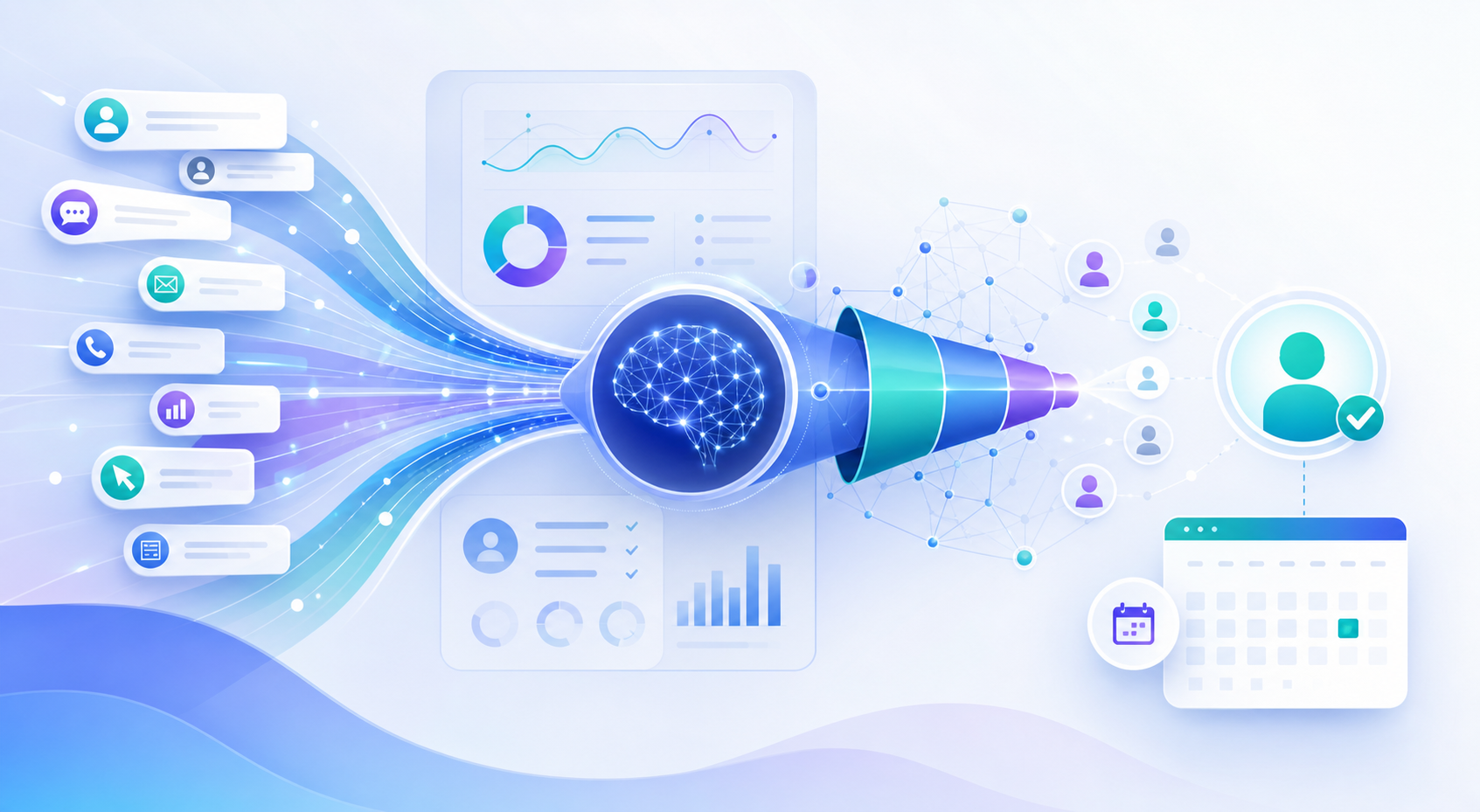
AI determines whether to book, route, or nurture a lead by combining two separate judgments: intent (how ready the person is to take action) and fit (how closely they match your ideal customer profile). In appointment-driven sales, the best systems score both continuously from conversation, behavior, CRM history, and operational constraints—then explain *why* a lead qualified.
How AI Evaluates Lead Intent in Appointment-Driven Sales
In appointment-driven sales, the AI’s job is not simply to detect interest. It must answer a more practical question: Is this person likely to benefit from, attend, and progress from a scheduled meeting?
That means intent modeling usually looks at a bundle of signals rather than one trigger such as “asked for pricing.” A prospect who asks for price but refuses to share timeline, location, or use case may be curious—not ready. By contrast, someone who asks about onboarding steps, available time slots this week, and required integrations is often showing high booking intent.
The three intent layers AI looks for
1. Stated intent
This is what the lead explicitly says:
- “Can I book a demo for tomorrow?”
- “Do you serve multi-location clinics?”
- “What do you need from us to get started?”
- “Can someone call me this afternoon?”
These are easy for AI to detect with natural language understanding. Modern systems can classify conversation topics, extract entities like dates and company size, and identify booking requests from chat, email, SMS, web forms, and voice transcripts. Tools in this category often rely on intent classification, entity extraction, and summarization capabilities described in enterprise conversational AI and CRM tooling such as Salesforce Einstein and HubSpot’s AI features.
2. Implied intent
This is where AI becomes more valuable than static form logic. Implied signals include:
- Replying within minutes instead of days
- Returning to the pricing or scheduling page multiple times
- Asking implementation-specific questions
- Mentioning current pain (“our reps are missing inbound calls”) rather than generic curiosity
- Comparing vendors or asking migration questions
A lead saying “just exploring” may still score high on implied intent if their behavior and follow-up questions indicate active evaluation.
3. Operational intent
In appointment-driven sales, booking readiness also depends on whether a meeting is feasible now. AI checks practical constraints such as:
- Is the lead in a supported geography?
- Are they requesting a service you actually offer?
- Are they available during supported scheduling windows?
- Is the inquiry urgent enough to justify immediate routing?
This matters because high interest without operational feasibility often creates no-show-prone or low-value appointments.
AI Separates Lead Intent from Lead Qualification
One of the most common mistakes in sales automation is treating intent and qualification as the same thing. Good AI does not do that.
Intent answers: “Do they want to move now?”
Intent is about timing and momentum:
- Are they trying to solve this soon?
- Are they willing to schedule?
- Are they asking decision-stage questions?
Qualification answers: “Should your team spend time here?”
Qualification is about fit:
- Are they the right buyer profile?
- Can they actually purchase?
- Is the deal likely to be viable?
This distinction is essential. A lead can be:
- High intent, low fit: Ready to buy, but outside your target region or too small for your service model
- Low intent, high fit: Perfect account, but only researching for next quarter
- High intent, high fit: Ideal booking candidate
- Low intent, low fit: Candidate for nurture or disqualification
This mirrors qualification frameworks widely used in sales, such as BANT and related discovery logic documented by HubSpot and other sales organizations.
The Qualification Criteria AI Commonly Uses
Most appointment-setting AI uses a rules-plus-model approach. The model detects patterns; the rules enforce business reality.
1. Need or use case
The AI determines whether the lead has a real problem your team solves.
Examples:
- A dental practice asking for after-hours call handling
- A SaaS company seeking inbound demo qualification
- A home services business wanting 24/7 appointment booking
A vague “tell me more” inquiry usually ranks lower than a concrete use case tied to workflow, revenue, staffing, or service delivery.
2. Budget or commercial viability
The AI may ask directly about budget, but often infers viability from context:
- Team size
n- Existing software stack
- Number of locations
- Current spend on ads or staffing
- Requested service level
For example, a lead wanting custom implementation, multi-location routing, and CRM integration is often more commercially viable than a solo operator asking for enterprise features.
3. Timeline and urgency
This is a strong booking predictor. AI looks for phrases such as:
- “ASAP”
- “This week”
- “Before our next campaign”
- “Our current vendor is failing”
Urgency becomes more reliable when paired with specifics. “Soon” is weaker than “we launch in 10 days and need overflow coverage before then.”
4. Authority or decision role
Not every appointment needs the final decision-maker, but AI should identify buying influence. Signals include:
- Job title in form or email signature
- Statements like “I’m evaluating vendors for our team”
- Mentions of procurement, founder, owner, or operations leadership
If the lead is a researcher with no internal influence, AI may still route them—but often with lower priority.
5. Company, household, or account fit
The fit check depends on the business model. Criteria may include:
- Industry or vertical
- Company size or location count
- Revenue band
- Geography or service radius
- Language support needs
- Technical environment
For local service businesses, zip code may matter more than employee count. For B2B SaaS, CRM stack and inbound volume may matter more than geography.
6. Data quality and consent
AI should not book aggressively from incomplete or non-compliant records. Qualification often includes:
- Valid phone or email
- Consent to contact where required
- Duplicate checking in CRM
- Spam/fake lead detection
For messaging and calling workflows, compliance matters. Businesses should ensure outbound practices align with applicable rules and guidance such as the FTC’s Telemarketing Sales Rule overview and platform-specific communication policies.
What Signals Increase Booking Confidence
The highest-performing appointment AI does not rely on one “magic phrase.” It accumulates confidence.
Strong positive signals
- Specific request for a meeting, callback, or demo
- Willingness to share business context
- Mention of current pain, deadlines, or switching drivers
- Confirmation of role, location, or business type
- Engagement with scheduling options
- Consistent details across form, chat, and call
Weak or negative signals
- Refusal to answer basic qualifying questions
- Contradictory information
- Personal email for a clearly enterprise request with no company details
- Requests outside service scope
- Repeated reschedules or noncommittal language
- Obvious research/student/vendor inquiries
A practical approach is to treat these as weighted features rather than hard yes/no gates. For example:
- +30: asks to book this week
- +20: matches target industry
- +15: confirms use case your team prioritizes
- -25: outside service geography
- -20: no valid contact method
The exact values vary by business, but the design principle is the same: use AI to estimate probability, and rules to protect sales capacity.
How Voice AI and Chat AI Qualify Differently
Voice AI and chat AI can use the same qualification framework, but they capture different types of evidence.
Voice AI strengths
- Detects urgency in real-time phrasing
- Handles after-hours inbound calls
- Clarifies ambiguous responses immediately
- Converts missed-call traffic into qualified appointments
Platforms such as Google Cloud Contact Center AI and Twilio support conversational routing, speech processing, and workflow automation that businesses can use to build qualification flows.
Chat AI strengths
- Great for structured data capture
- Easier to pass URLs, pricing pages, and calendars
- Convenient for multi-step qualification before booking
- Produces clean transcripts and field extraction
Best practice
Use voice for urgency-heavy or call-driven channels, and chat for web qualification and scheduling. If both channels exist, unify them in the CRM so the AI can reference prior interactions rather than asking the same questions twice.
A Practical Qualification Workflow for Appointment Setting
Here is a simple model many teams can implement.
Step 1: Verify identity and contactability
Capture:
- Name
- Company or household context
- Phone/email
- Consent
Step 2: Identify need
Ask 1-2 targeted questions:
- “What are you trying to solve?”
- “What happens today when a prospect calls or books?”
Step 3: Measure fit
Check ICP criteria:
- Industry
- Geography
- Size or volume
- Service requirements
Step 4: Measure timing and readiness
Ask:
- “Are you evaluating now or planning for later?”
- “When do you want a solution in place?”
Step 5: Decide the next action
- Book now: high fit + high intent + valid contact data
- Route to human review: complex opportunity or unclear responses
- Nurture: good fit but weak timing
- Disqualify politely: poor fit, unsupported use case, or no consent
What the Sales Handoff Should Include
The AI should never hand off only a calendar event. It should deliver a short, useful briefing.
Minimum handoff summary
- Who the lead is
- Their problem/use case
- Qualification status and why
- Timeline/urgency
- Relevant constraints
- Source channel and transcript summary
Example:
> Qualified, high intent. Operations manager at a 4-location med spa. Wants after-hours booking and missed-call coverage before a campaign launching in 2 weeks. Uses HubSpot. Confirmed budget discussion is appropriate on first call. Requested demo Tuesday afternoon.
That summary saves reps from repeating discovery and improves meeting quality.
Metrics to Track So the AI Actually Improves Sales
Do not evaluate qualification AI only on booked meetings. That can reward low-quality scheduling.
Track:
- Appointment booking rate
- Qualified-to-held meeting rate
- No-show rate
- Sales acceptance rate
- Speed to first response
- Opportunity creation rate from meetings
- Revenue per booked appointment
If booked meetings rise but held meetings and pipeline quality fall, the AI is overbooking weak leads. This is one reason CRM-based reporting matters; major vendors like Salesforce and HubSpot emphasize connecting marketing, qualification, and downstream revenue data in one system.
How to Set Better Qualification Rules
The best qualification logic is not generic. It should reflect your actual top-rep behavior and your win/loss data.
Build rules from real outcomes
Review the last 50-100 meetings and label them:
- Held vs. no-show
- Accepted vs. rejected by sales
- Opportunity vs. dead end
- Closed-won vs. lost
Then identify patterns such as:
- Which use cases convert best
- Which titles show up and buy
- Which geographies create operational issues
- Which channels produce low-quality inquiries
Turn those findings into AI rules and prompts. For example:
- “Do not auto-book student, job-seeker, or vendor inquiries.”
- “Require zip code for home-services bookings.”
- “Escalate any multi-location healthcare lead to senior rep.”
- “If timeline is over 6 months, nurture instead of booking unless account is enterprise.”
That is how AI moves from generic automation to revenue-supporting qualification.
FAQ
How does AI know whether a lead is ready to book an appointment?
AI looks at explicit requests, urgency language, scheduling behavior, and decision-stage questions. It also checks whether the lead’s details are complete enough and whether the request matches operational constraints such as geography, service scope, and available time slots.
What is the difference between lead intent and lead qualification?
Intent measures readiness to act now; qualification measures whether the lead fits your ideal customer profile and sales criteria. A lead can have high intent but still be a poor fit, or be a great fit but not ready for a meeting yet.
Can AI qualify leads without asking too many questions?
Yes. Strong systems combine direct questions with existing CRM data, website behavior, prior conversations, and form fields. The goal is progressive qualification: ask only the minimum needed to decide whether to book, route, nurture, or disqualify.
What criteria should businesses use first?
Start with four groups: fit, need, timing, and contactability. In practice, that means checking whether the lead matches your target profile, has a real use case, is evaluating within a meaningful timeframe, and can be contacted compliantly.
How should teams measure whether AI qualification is working?
Look beyond raw appointment volume. Track held-meeting rate, sales acceptance rate, no-show rate, opportunity creation, and revenue per appointment. If bookings rise but pipeline quality drops, your AI is likely too permissive.
References
- https://appointify.ai
- https://liveassist.io/blog/how%E2%80%91ai%E2%80%91chatbots%E2%80%91qualify%E2%80%91leads%E2%80%91automatically
- https://liveassist.io/blog/how-ai-chatbots-qualify-leads-automatically
- https://solvea.cx/blog/how%E2%80%91does%E2%80%91ai%E2%80%91assist%E2%80%91in%E2%80%91lead%E2%80%91qualification
- https://solvea.cx/blog/how-does-ai-assist-in-lead-qualification
- https://www.pedowitzgroup.com/ai%E2%80%91agents%E2%80%91qualify%E2%80%91leads%E2%80%91autonomously%E2%80%91governed%E2%80%91guide
FAQ
How does AI differentiate a serious lead from a casual browser?
AI analyzes responses, urgency, and matching with target profiles to identify serious leads. Key indicators include specific needs and willingness to schedule.
Can AI book appointments without prior qualification?
While technically possible, booking without qualification often leads to inefficiencies. It's better to screen for fit and intent first, ensuring valuable engagements.
What type of questions does AI commonly ask during lead qualification?
AI typically asks about needs, timelines, budgets, locations, and decision-making authority to evaluate the lead's readiness for booking.
What makes voice AI particularly useful for sales?
Voice AI captures nuance and urgency quickly, helping qualify leads in real-time and effectively transitioning high-intent, qualified leads into scheduled meetings.