 Appointify AI
Appointify AI › Blog › How a Voice AI Chatbot Qualifies Leads Before Booking an Appointment
← All articlesHow a Voice AI Chatbot Qualifies Leads Before Booking an Appointment
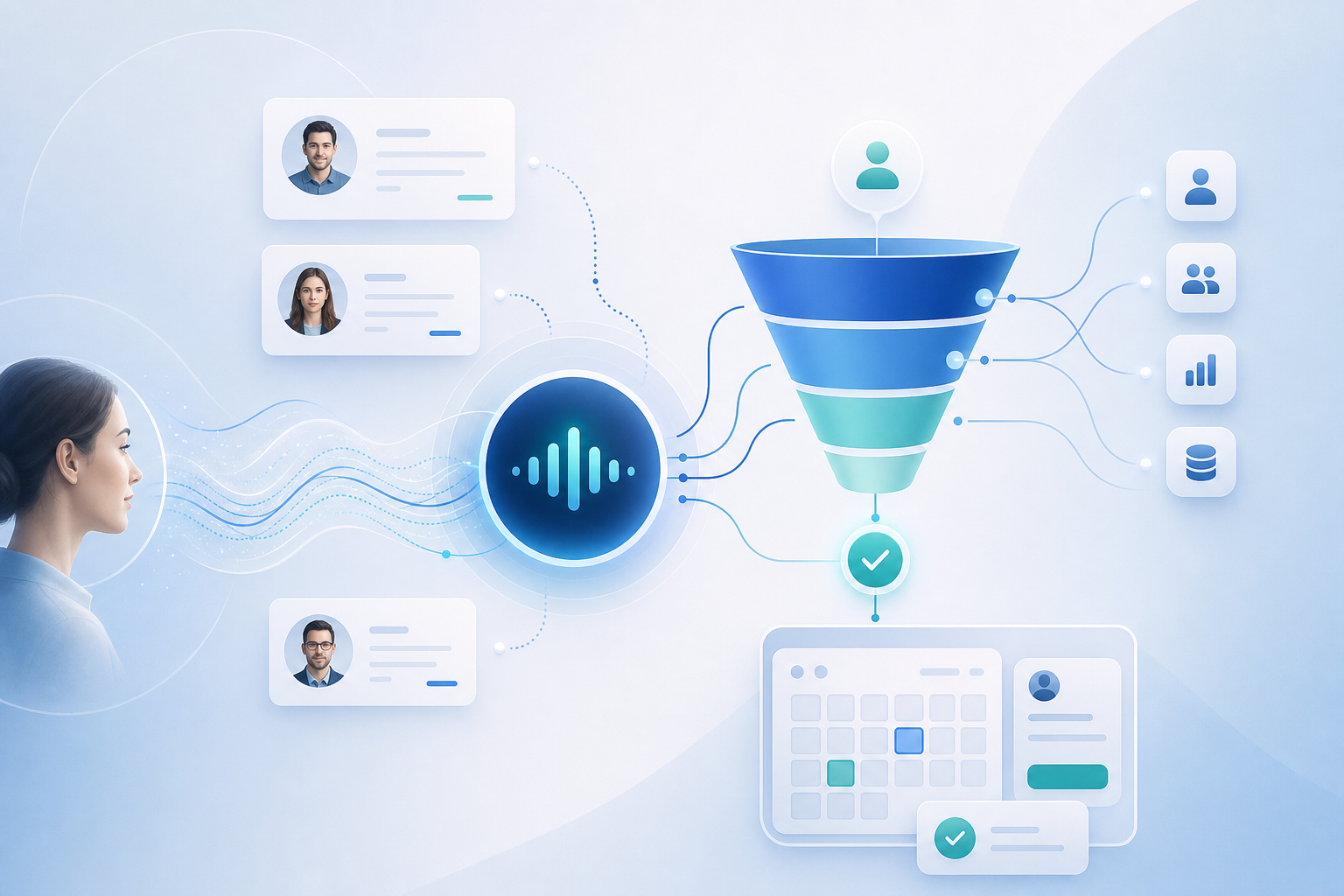
Voice AI chatbots qualify leads by running a short, structured conversation before anyone reaches your calendar. In practice, they verify intent, collect contact data, screen for fit using business rules, handle objections, and only then offer booking options—reducing no-shows, saving sales time, and routing unqualified inquiries elsewhere.
What lead qualification with a voice AI chatbot actually looks like
A voice AI chatbot is not just a talking calendar widget. The useful version sits between first contact and appointment booking and answers one question fast: should this person book time with your team, and if so, with whom?
Before a meeting is offered, the bot typically does five jobs:
1. Identifies intent — sales inquiry, support, job application, partnership, or spam.
2. Captures core details — name, company, phone, email, location.
3. Checks qualification criteria — budget, urgency, geography, service need, company size, insurance type, case type, or property details depending on the business.
4. Scores or routes the lead — qualifies for sales, sends to support, or offers a callback/request form.
5. Books the right appointment — with the correct rep, duration, and calendar rules.
This matters because speed strongly influences conversion. Harvard Business Review famously reported that firms responding within an hour were far more likely to qualify a lead than those waiting longer, underscoring why instant screening matters in the first place (Harvard Business Review).
The qualification flow: step by step
1. The bot opens with intent detection
The first 10–20 seconds should separate buyers from everyone else.
A strong opener sounds like:
> “Thanks for calling. I can help book a consultation, answer a support question, or route you to the right team. What are you looking for today?”
That one prompt often filters out a large share of non-sales conversations. If the caller says “I need help with my existing account,” the bot should not push them into a sales calendar.
2. It asks only the minimum viable qualification questions
Good voice qualification feels short and relevant. Bad voice qualification feels like an interrogation.
Most businesses should keep it to 3–6 core questions before booking. Typical categories include:
- Need: What problem are you trying to solve?
- Fit: Are you in our service area / ICP / accepted case type?
- Timeline: How soon do you need help?
- Scale: Team size, project size, number of locations, estimated volume.
- Budget or commercial readiness: Do you have an approved budget or target range?
- Authority: Are you the decision-maker or part of the buying team?
3. It applies rules, not just transcription
The key difference between a basic voice assistant and a lead-qualifying system is logic.
Examples of qualification rules:
- SaaS demo booking: Only book if company has 20+ employees, use case matches product, and timeline is under 6 months.
- Law firm intake: Only book if case type is handled in that state and is within statute-related urgency thresholds; otherwise route to another resource.
- Home services: Only book if ZIP code is in service area, issue type matches offering, and customer confirms property ownership or authorized decision-making.
- B2B agency: Only book strategy calls when monthly budget exceeds a threshold and the buyer needs service within the next quarter.
This is similar in spirit to lead scoring and routing practices used in modern CRM workflows. Platforms like HubSpot and Salesforce explicitly support lead scoring, segmentation, and automated routing because qualification quality affects pipeline efficiency (HubSpot, Salesforce).
4. It handles edge cases before offering the calendar
A strong voice AI flow does more than ask questions in a fixed order. It should also know what to do when the answer is incomplete or contradictory.
Examples:
- If the caller says “I’m not sure of budget,” the bot can ask for range or stage: “Are you evaluating options, or have funds already been approved?”
- If the caller asks about price too early, the bot can give a narrow estimate or explain pricing factors before continuing.
- If the caller is unqualified, the bot can offer a useful alternative: email resources, a support ticket, a referral partner, or a waitlist.
5. It books using scheduling constraints
Once qualified, the bot should book intelligently, not just find any open slot.
Useful scheduling constraints include:
- Round-robin assignment by territory or vertical
- Different meeting lengths by lead type
- Buffer times between calls
- “No same-day demos after 4 p.m.” rules
- Priority slots for high-value leads
- Language matching if multilingual reps are available
Scheduling platforms such as Calendly and Google Calendar make these controls straightforward to implement through integrations or APIs (Calendly, Google Calendar).
What questions should a voice AI chatbot ask?
The right questions depend on your sales model. Here are practical examples by industry.
B2B software
1. “What are you looking to solve today?”
2. “How many people would use the platform?”
3. “Which tools are you using now?”
4. “Are you evaluating for this quarter or later?”
5. “Who besides you will be involved in the decision?”
Book if: use case fits, team size is in range, and timeline is active.
Law firm intake
1. “What type of legal issue are you calling about?”
2. “Which state is this matter in?”
3. “When did the issue happen?”
4. “Are you calling for yourself?”
5. “What is the best number and email for follow-up?”
Book if: practice area and jurisdiction match.
HVAC or plumbing
1. “What issue are you experiencing?”
2. “What is the property ZIP code?”
3. “Is this an emergency or can it wait a day or two?”
4. “Do you own the property?”
5. “What time works best for a technician?”
Book if: address is in service area and issue matches offered services.
Financial or insurance services
1. “Are you looking for personal or business coverage?”
2. “Which state are you located in?”
3. “Do you currently have a policy?”
4. “When does your current policy renew?”
5. “What’s the best way to contact you?”
Book if: licensing and product fit are valid.
A practical qualification framework you can copy
A simple model is to classify each answer into one of four buckets:
Must-have criteria
These are non-negotiable.
Examples:
- In service area
- Supported case or product type
- Valid phone/email
- Not an existing support issue disguised as sales
If a must-have is missing, the bot should not book.
Fit criteria
These indicate whether the lead matches your ideal customer profile.
Examples:
- Company size
- Revenue band
- Property type
- Number of locations
- Industry
Readiness criteria
These measure buying intent.
Examples:
- Urgency
- Budget approval
- Decision-maker access
- Active project timeline
Routing criteria
These decide who should take the meeting.
Examples:
- Enterprise vs SMB rep
- New patient vs returning patient
- Litigation vs family law intake
- English vs Spanish queue
What the bot should capture in your CRM
Before the appointment is created, the system should write structured data into your CRM, not just a call transcript.
Minimum fields to store:
- Full name
- Phone number
- Email address
- Company name if relevant
- Lead source
- Qualification responses
- Qualification outcome: qualified, disqualified, nurture, support
- Appointment owner
- Transcript and summary
- Consent or disclosure status where required
This is where tools like HubSpot, Salesforce, and Zapier become useful. The voice layer handles conversation; the CRM handles recordkeeping, automations, and reporting (Zapier).
Common mistakes that make voice qualification fail
Asking too many questions
If the bot asks eight to ten questions before offering help, drop-off rises. Keep pre-booking questions to what sales actually needs.
Treating every lead the same
A first-time residential plumbing call and a commercial maintenance inquiry should not follow the same script.
No fallback for ambiguous answers
People speak vaguely. Your bot needs clarification prompts like “Do you mean this month or later this year?”
Booking unqualified leads anyway
This is the fastest way to make reps hate the system. If a lead fails the business rules, route them elsewhere.
Ignoring compliance
If calls are recorded or summarized, disclose that where required. Depending on industry and geography, privacy and consent requirements may apply. Review applicable guidance and local law before deployment; the Federal Trade Commission’s privacy and AI guidance is a good starting point (FTC).
How to tell if your voice AI qualification is working
Track operational metrics, not just booked meetings.
Useful metrics include:
- Percentage of calls correctly identified as sales vs non-sales
- Qualified-to-booked rate
- Disqualified rate by reason
- Show rate by qualification path
- Speed to first response
- Human takeover rate
- Average qualification time
- Calendar utilization by rep or territory
The best signal is simple: are booked meetings more likely to be relevant, show up, and move to opportunity?
Best practices for a better caller experience
- Open with purpose in one sentence.
- Confirm one detail at a time.
- Use conversational language, not form labels.
- Offer alternatives when the lead is not a fit.
- Repeat back critical details like email, phone, date, and time.
- Send immediate SMS or email confirmation after booking.
Final takeaway
A voice AI chatbot qualifies leads before booking by combining conversation, business rules, and scheduling logic. The most effective systems do not merely collect details—they filter for fit, route intelligently, and protect your sales team’s calendar. If you keep the flow short, capture structured CRM data, and enforce clear qualification rules, voice AI can turn more inbound interest into better appointments.
FAQ
How many questions should a voice AI chatbot ask before booking?
Usually 3 to 6. Enough to verify fit and readiness, but not so many that callers drop off. Start with must-have criteria first.
Can a voice AI chatbot disqualify leads automatically?
Yes. If the bot checks clear business rules—such as service area, budget range, case type, or company size—it can route non-fit leads to support, self-service resources, or a callback form instead of booking.
What systems should a voice AI chatbot integrate with?
At minimum: a calendar, CRM, and messaging/email tool for confirmations. Common combinations include Salesforce or HubSpot with Calendly, Google Calendar, and Zapier.
Is voice better than a web form for lead qualification?
Sometimes. Voice can feel faster and more natural for urgent or high-intent inquiries, especially after hours or on mobile. Forms still work well for lower-intent or documentation-heavy processes.
What is the biggest mistake in voice lead qualification?
Booking everyone. If the bot does not enforce qualification logic, it becomes a scheduling tool—not a lead qualification system.
References
- https://appointify.ai
- https://appointify.ai/blog/ai-appointment-booking-agent-how-appointify-ai-automates-lead-capture-and-meeting-scheduling
- https://appointify.ai/blog/ai-appointment-booking-agent-enhance-your-lead-conversion-with-appointify-ai
- https://appointify.ai/blog/what-is-an-ai-appointment-booking-agent-how-appointify-ai-automates-lead-capture-and-scheduling
FAQ
How many questions should a voice AI chatbot ask before booking?
Usually 3 to 6. Ask only what is needed to verify fit, urgency, and routing before offering calendar slots.
Can a voice AI chatbot disqualify leads automatically?
Yes. It can apply business rules such as geography, case type, budget, company size, or urgency and then route unqualified leads to other options instead of booking.
What systems should a voice AI chatbot integrate with?
At minimum, a calendar, CRM, and messaging or email platform for confirmations. Many businesses use tools like HubSpot, Salesforce, Calendly, Google Calendar, and Zapier.
Is voice better than a web form for lead qualification?
Voice is often better for urgent, high-intent, or mobile users because it feels immediate and conversational. Forms may still be better for lower-intent or documentation-heavy workflows.
What is the biggest mistake in voice lead qualification?
Allowing every inquiry to book time. Without clear qualification rules, the bot fills calendars with low-fit meetings and reduces sales efficiency.