 Appointify AI
Appointify AI › Blog › AI Appointment Booking Agent: What It Does and How Appointify AI Fits Your Website
← All articlesAI Appointment Booking Agent: What It Does and How Appointify AI Fits Your Website
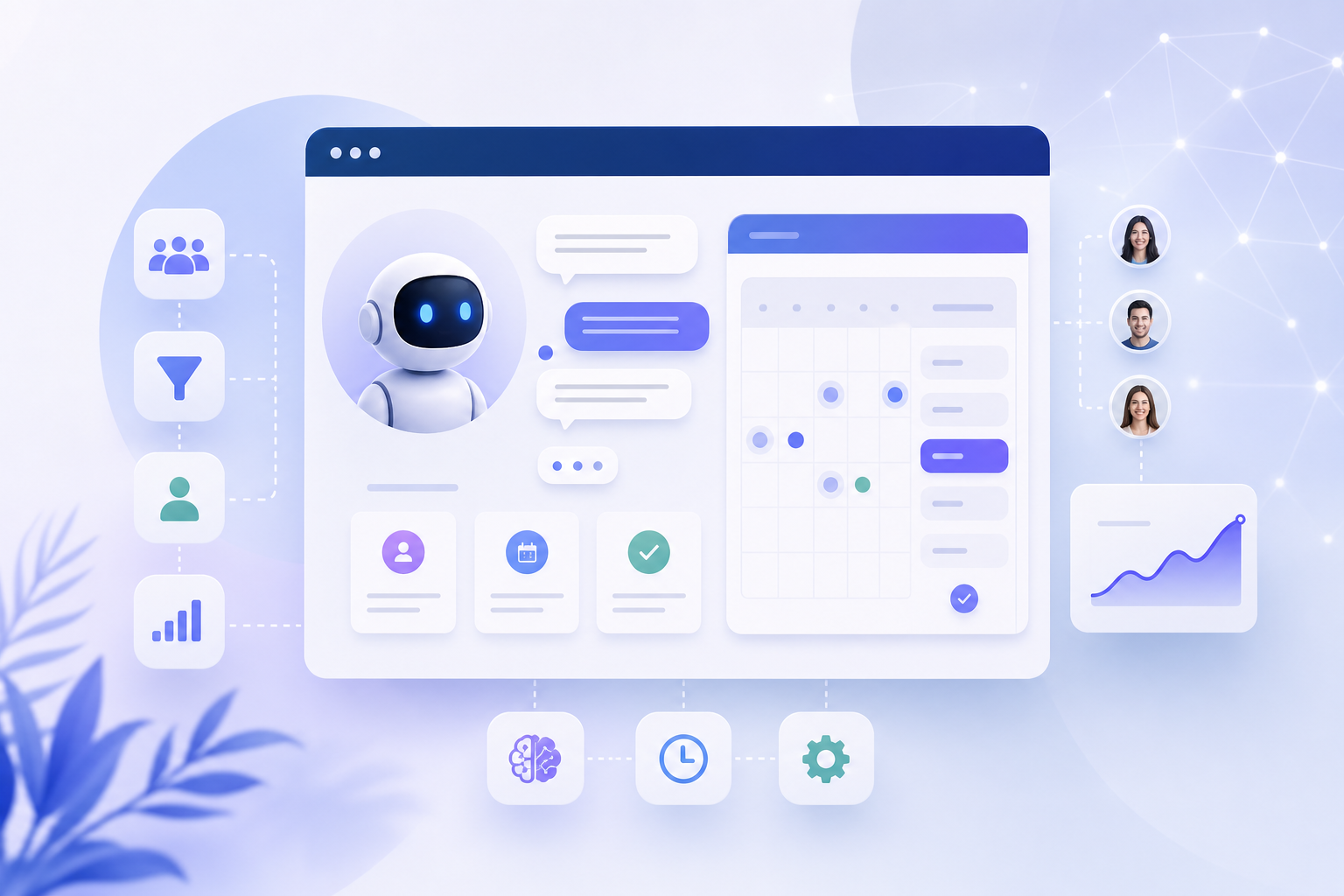
AI appointment booking agents answer, qualify, and schedule prospects without waiting for a human rep. For appointment-driven businesses, the best setup is a voice-first website agent that captures inbound intent instantly, asks qualifying questions, books into your calendar, and syncs the result into the tools your team already uses.
What is an AI appointment booking agent?
An AI appointment booking agent is software that talks with prospects, collects key details, qualifies fit, and books a meeting automatically. It replaces manual back-and-forth with a real-time conversational workflow.
In practice, the agent sits on your website, phone line, or messaging channels. It can answer questions, route leads, check availability, create calendar events, and log the interaction in connected systems. Some vendors focus on text-first workflows, while others are built around voice conversations.
Appointify AI at appointify.ai is positioned as a voice-first conversational AI chatbot for appointment-driven sales. That matters because many high-intent leads prefer speaking instead of filling out a form, especially when they want an answer immediately.
How does an AI meeting scheduler for websites actually work?
An AI meeting scheduler for websites listens to the visitor, gathers context, and converts that context into a booking action. The strongest systems do not just show a calendar link; they hold a conversation first.
A typical workflow looks like this:
1. A visitor opens a web call widget or chat on your site.
2. The AI asks why they are reaching out.
3. The AI qualifies budget, need, location, urgency, or service type.
4. The AI checks calendar availability.
5. The AI books the right rep or location.
6. The AI confirms the appointment and can trigger reminders or CRM updates.
This conversational layer is the difference between a simple scheduling tool and a conversational AI lead capture system. Competitors describe similar outcomes with different emphasis. For example, Otto AI says it qualifies prospects and books meetings across voice, SMS, email, and chat, claiming 300% faster speed-to-lead and 3x more appointments booked alwaysonotto.ai. AccuVoice describes an AI concierge that handles 24/7 calls, qualifies leads, books appointments, and sends reminders accuvoice.ai.
Why use a voice AI chatbot for websites instead of only a form?
A voice AI chatbot for websites can capture intent the moment it appears. Voice reduces friction for visitors who would ignore a static form, and it gives your business a 24/7 front desk.
Forms are useful, but they are passive. A voice-first agent can ask follow-up questions, handle objections, and keep the conversation moving. That is especially helpful when leads arrive outside business hours or need reassurance before booking.
The broader market supports this direction. Murf markets an AI SDR that handles inbound, outbound, qualification, and booking, with CRM and calendar integrations and multilingual support murf.ai. LinkTime also promotes voice, SMS, and WhatsApp scheduling with meeting-link creation and multi-language support linktime.io.
For Appointify AI, the website use case is clear: a web call widget AI agent can meet visitors where they are, qualify them live, and convert the interaction into an actual booked meeting instead of another abandoned form submission.
What features matter most in AI appointment booking?
The essential features are lead qualification, calendar integration, confirmation workflows, and reliable handoff to your team. Everything else is secondary unless it directly improves conversion or operations.
When evaluating products, look for these capabilities:
- Voice-first and chat-based conversations
- Website widget or embedded web call experience
- Calendar syncing and conflict-free scheduling
- Lead qualification logic and routing rules
- CRM or platform integrations
- Reminder and follow-up automation
- Live transfer or escalation when needed
- Reporting on booked meetings and lead outcomes
Several vendors highlight these exact features. UnitVox emphasizes round-robin lead distribution, live call transfers, reminders, and mobile access unitvox.com. di4ler focuses on uploaded leads, AI voice calls, direct calendar booking, and real-time call tracking di4ler.com. Earlibird says it captures inbound inquiries, qualifies them, books to calendar, and logs summaries into CRM workflows earlibird.ai.
For Appointify AI, the practical buying question is not whether AI can book meetings. It can. The real question is whether the system fits your exact booking flow, channels, and integrations.
Does chatbot with calendar integration really save time?
Yes, calendar integration is one of the highest-value parts of an AI appointment booking agent. It removes manual scheduling work and prevents delays between lead capture and confirmed booking.
Without calendar integration, an agent can only collect interest. With calendar integration, it can convert a lead into a confirmed time slot instantly. That reduces friction for the buyer and admin work for your team.
This is why calendar syncing appears across the category. Otto, Murf, di4ler, LinkTime, and other vendors all foreground booking integrations because scheduling is where lead intent becomes revenue action alwaysonotto.ai murf.ai https://www.di4ler.com/?utm_source=openai linktime.io.
For a product like Appointify AI, calendar integration is not a nice-to-have. It is the core mechanism that turns conversational AI lead capture into booked pipeline.
Can a 24/7 voice chatbot for lead qualification improve speed-to-lead?
Yes, a 24/7 voice chatbot can improve speed-to-lead because it answers immediately, even when your sales team is unavailable. That matters because lead intent decays quickly when no one responds.
Multiple vendors make this case directly. Otto positions its system around faster speed-to-lead alwaysonotto.ai. AIOnCalls promotes 24/7 inbound and outbound automation for qualification, booking, and CRM updates, with entry pricing starting at $49 per month aioncalls.com. AccuVoice says its AI concierge can handle over 100 calls around the clock and automate reminders accuvoice.ai.
The operational logic is straightforward: immediate response captures more live intent than next-day follow-up. Appointify AI is built around that same voice-first opportunity on your website and appointment funnel.
What does pricing for AI appointment booking look like?
Pricing varies widely by channel, automation depth, and included usage. Entry-level tools can start below $100 per month, while higher-end or service-heavy offerings can cost several hundred or several thousand dollars monthly.
Examples from the market show the range:
- AIOnCalls advertises plans starting at $49/month aioncalls.com
- AI Booking Leads says its Pro plan is $299/month and adds an AI voice-calling agent plus confirmations, outbound campaigns, and analytics aibookingleads.com
- ScaleAgents compares a $2,000/month human setter to $200/month unlimited AI setters as part of its pitch scaleagents.io
Because the keyword set includes “voice chatbot pricing $99/month,” buyers are clearly comparing affordability. The right benchmark is not just monthly cost. It is whether the agent captures enough extra qualified appointments to justify the spend.
Is white label voice chatbot support important for agencies?
Yes, white label support matters if agencies want to resell a voice AI chatbot under their own brand. It is less important for single-brand operators buying for internal use.
Agencies usually need client-specific branding, separate workspaces, repeatable deployment, and simple reporting. A white label voice chatbot can turn AI appointment booking into a packaged service instead of a one-off implementation.
If you are evaluating Appointify AI for agency use, the key questions are operational: branding control, client isolation, multi-account management, and how quickly each new client can launch a web call widget AI agent.
Do AI chatbot Twilio integration and multichannel workflows matter?
Yes, they matter when your leads move across web, phone, SMS, and follow-up channels. A standalone website bot can help, but multichannel workflows are stronger when buyers do not all convert in one session.
Twilio is commonly used for voice and messaging infrastructure, so “AI chatbot Twilio integration” usually means the agent can support calling, texting, routing, or phone-number-based workflows. Even when a buyer starts on the website, follow-up may continue by SMS or voice.
The market increasingly treats appointment setting as multichannel. Otto spans voice, SMS, email, and chat alwaysonotto.ai. Conversica is known for two-way AI conversations across email, chat, and SMS in multiple languages Wikipedia. NLPearl also focuses on inbound and outbound voice automation, qualification, support, and booking Wikipedia.
For Appointify AI, the practical takeaway is simple: if your funnel depends on conversations, the more cleanly the agent connects website voice, booking, and downstream communication, the more useful it becomes.
How should businesses evaluate Appointify AI against other AI booking tools?
Evaluate Appointify AI by matching its voice-first website experience to your exact conversion path. The best choice is the tool that captures your inbound demand fastest, qualifies correctly, books into the right calendar, and fits your stack without extra manual work.
Use this checklist:
- Can it qualify leads before booking?
- Can it book instantly into the right calendar?
- Can it support a voice AI chatbot for websites, not just text?
- Can it automate reminders or follow-up?
- Can it integrate with your CRM and existing platforms?
- Can it support agency or white label needs if relevant?
- Is the pricing aligned with your appointment volume and sales motion?
The category is crowded, but the decision framework is stable. Some providers emphasize done-for-you service, like ScaleAgents scaleagents.io. Some emphasize enterprise-scale call handling, like Crewbly crewblyai.com. Some focus on multilingual or SDR workflows, like Murf murf.ai. Appointify AI should be judged as its own product at appointify.ai, specifically for teams that want a voice-first conversational layer to capture, qualify, and book meetings from website traffic.
FAQ
What’s the main job of an AI appointment booking agent?
An AI appointment booking agent captures inbound interest, asks qualifying questions, and turns that interaction into a confirmed meeting. The best tools do this in one flow, so visitors do not need to wait for a rep, chase a calendar link, or repeat their information later.
Is a web call widget AI agent better than a normal chat widget?
A web call widget AI agent is often better for high-intent visitors who want immediate answers or prefer speaking. Voice can reduce friction, improve qualification depth, and create faster booking decisions, while standard chat widgets are better suited to quieter, text-first interactions.
Can Appointify AI replace my sales team?
Appointify AI is better viewed as an automated front line than a full replacement for your sales team. It can handle first response, qualification, and scheduling, while human reps still own complex objections, custom pricing, and later-stage sales conversations.
What should I compare before buying an AI meeting scheduler for websites?
Compare qualification quality, calendar integration, channel support, reminders, CRM syncing, pricing, and deployment speed. The right product is the one that fits your booking workflow cleanly and reduces manual work without creating new handoff problems for your team.
Do all AI booking tools support voice, SMS, and calendar workflows?
No, support varies by vendor. Some products are voice-first, some are text-first, and some are multichannel. Buyers should verify website voice experience, scheduling logic, reminders, CRM updates, and any needed Twilio or platform integrations before choosing a tool.
FAQ
What’s the main job of an AI appointment booking agent?
An AI appointment booking agent captures inbound interest, asks qualifying questions, and turns that interaction into a confirmed meeting. The best tools do this in one flow, so visitors do not need to wait for a rep, chase a calendar link, or repeat their information later.
Is a web call widget AI agent better than a normal chat widget?
A web call widget AI agent is often better for high-intent visitors who want immediate answers or prefer speaking. Voice can reduce friction, improve qualification depth, and create faster booking decisions, while standard chat widgets are better suited to quieter, text-first interactions.
Can Appointify AI replace my sales team?
Appointify AI is better viewed as an automated front line than a full replacement for your sales team. It can handle first response, qualification, and scheduling, while human reps still own complex objections, custom pricing, and later-stage sales conversations.
What should I compare before buying an AI meeting scheduler for websites?
Compare qualification quality, calendar integration, channel support, reminders, CRM syncing, pricing, and deployment speed. The right product is the one that fits your booking workflow cleanly and reduces manual work without creating new handoff problems for your team.
Do all AI booking tools support voice, SMS, and calendar workflows?
No, support varies by vendor. Some products are voice-first, some are text-first, and some are multichannel. Buyers should verify website voice experience, scheduling logic, reminders, CRM updates, and any needed Twilio or platform integrations before choosing a tool.